Did the iPhone Really Cause the Baby Bust?
A viral study blames the iPhone for falling US births, and the honest answer is stranger and more hopeful than the headline.

There’s a small glass rectangle within reach of your hand right now. A new study asks a strange question about it: is your phone a form of birth control?
The paper came out of the National Bureau of Economic Research (Myers & Hooper, NBER 2026), and the headline wrote itself: blame the iPhone for the baby bust. The timing is eerie. In June 2007, Apple put the first iPhone on sale (Apple 2007). That same year, US births hit their highest level since 1971, about 2.1 children per woman, right at the line that keeps a population flat (CDC/NCHS). Then the line turned. Births fell almost every year since. Today an American woman has about 1.6 children, a 22 percent drop since 2007 (Myers & Hooper, NBER 2026). The honest answer is more interesting than the headline.
Why the idea is so tempting
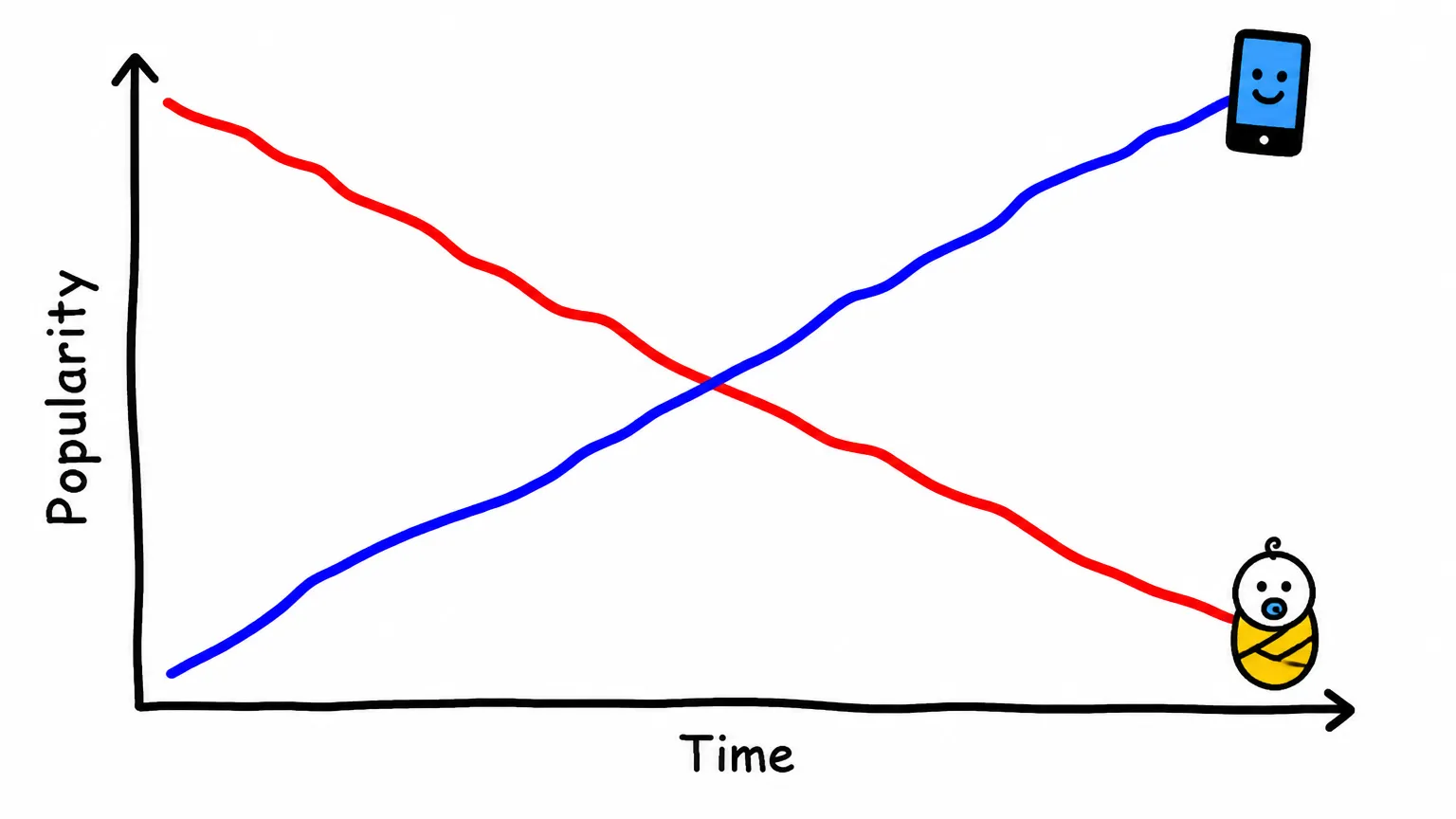
Put two lines on one chart. Smartphone ownership climbed from a third of US adults in 2011 to nine in ten today (Pew Research 2025), while the birth rate slid down the whole time. The two lines mirror each other almost perfectly, and when lines move like that, your brain screams that one caused the other. But lines can move together and mean nothing. The real question is whether anyone could prove the link. One economist decided to try.
The clever experiment
Caitlin Myers at Middlebury College faced one big problem. Almost everyone got a smartphone at roughly the same moment, so there was no clean group to compare against, no way to isolate the phone from everything else in those years.
Then she found a loophole in history. At launch, the iPhone worked on only one carrier, AT&T, and that deal lasted from June 2007 to February 2011 (Myers & Hooper, NBER 2026). An iPhone was only useful where AT&T had coverage, so history had accidentally split the country. Some counties had a strong AT&T signal; others right next door had almost none. Same economy, same year, and the main difference was whether you could use an iPhone.

Myers compared their birth rates. Where the iPhone arrived first, births fell faster. Her headline number is bold: the iPhone explains a third to a half of the birth decline among women under 45 (Myers & Hooper, NBER 2026). Then she ran the test that makes it convincing, checking Verizon and Sprint coverage before they sold any iPhone. If the phone were the cause, their maps should show nothing, and they did. A clean placebo. It’s careful work, but it’s early, and the paper hasn’t cleared peer review (Myers & Hooper, NBER 2026).
The detail everyone missed
The headlines skipped the most important part. The effect wasn’t spread evenly: it landed almost entirely on young women. Births fell by as much as 8 percent among teenagers, less in the early twenties, and by the thirties it nearly vanished (Myers & Hooper, NBER 2026).
That points at the biggest thread in the story. The US teen birth rate has fallen 68 percent since 2007, from about 42 births per thousand teens down to 13 (CDC/NCHS). It’s one of the steepest drops in the record. Most teen pregnancies were never planned, so fewer of them is a major public health win, hundreds of thousands of pregnancies avoided.
It fits something researchers tracked for years. The psychologist Jean Twenge measured the shift: the share of US high schoolers having sex fell from 54 percent to 41 (Twenge & Park 2019). Dating, drinking, and going out slid down together as a generation moved its social life onto a screen. So part of the effect is teenagers scrolling instead of getting pregnant, and that half of the story is good news.
Three problems
Does the phone explain the whole baby bust? Three problems say no.
First, the decline started long before the iPhone. The US slipped below replacement back in 1972, and a phone can’t cause a trend that began decades earlier. Myers agrees. She’s explaining a deeper dip on a slope that already existed.
Second, her study found no effect at all for Black women (Myers & Hooper, NBER 2026). If a phone were simply birth control, why would it skip anyone?
Third, and most honest, she names the weak spot herself. The strong-signal counties were also more urban, so anything pulling city births down would look identical on her map. And the decline is global, across countries with very different phones. Here’s the cleanest catch. The internet doesn’t only push births down. When fast home broadband reached Germany, births among college-educated women actually rose (Billari et al. 2019), because working from home let them combine a career and a kid. The web cuts both ways. The simple story, screens mean fewer babies, breaks down.
What’s actually going on
Two economists spent years on this puzzle. Melissa Kearney and Phillip Levine put every usual suspect on trial: housing costs, childcare, student debt, the recession, birth control, even religion. One by one, each suspect failed to explain much of the drop after 2007 (Kearney & Levine 2022). Their 2025 verdict was humbling. There’s no single lever anyone can pull (Kearney & Levine 2025). What they see is a generation quietly rebuilding what an adult life looks like: a career, more freedom, a partner found later. Parenthood still matters. It just shares a crowded calendar.
And they didn’t laugh off the phone. They name the iPhone, email, and social media directly as shocks that rewired how we work and meet (Kearney & Levine 2025). The phone probably didn’t start this fire. It mostly fed one already burning. And one number drives it home: births to US women under 30 fell, but births to women over 30 rose (CDC/NCHS). The early thirties are now peak baby years, a first on record (CDC/NCHS). People didn’t stop wanting children. Many just want them later, and fewer.
The honest answer
So did the iPhone cause the baby bust? It gave a real, measurable shove to one slice of the story, mostly fewer teen pregnancies, which we should be glad about. That shove sits on a decline that began in the 1970s and runs far deeper than any single gadget. A third to a half, says the researcher who built the case (Myers & Hooper, NBER 2026). And even she says, in a direct quote, “we are not saying it is all the iPhone” (Myers, CBS News 2026). The other half to two-thirds is still a mystery. A birth rate this low, that stays this low, is brand new in history. Nobody has solved it anywhere.
But before you panic: this is the slowest, biggest story of our lifetime, and a shrinking country isn’t the same as a crashing one. In almost every country that has shrunk so far, the average person kept getting richer (Nature H&SS Comms 2023). Panic forecasts have a long history of being wrong.
So look back at that glass rectangle in your hand. Whether it changes your mind about kids is the one thing it can’t decide for you.
I’m Paw, and this is where I’ll be every week: following the real numbers and the studies behind the scary headlines, calm, with every source on the table. If that’s your kind of read, subscribe, and pass this to one person still sharing the headline.